Hierarchy
Reactors can be composed hierarchically: any reactor can create and contain other reactors. This lets you build programs from well-defined building blocks and bundle related reactors into reusable components.
Creating and connecting nested reactors
The Reactor.create_reactor() method, which works just like
Environment.create_reactor(), creates a reactor that is owned by
the calling reactor rather than by the environment. Sub-reactors and their
internal connections are set up in the __init__ method of the container.
Consider the following example. Copy it into a new file called
scaled_counter.py and add the required imports at the top.
import datetime

import xronos


class Counter(xronos.Reactor):
    output = xronos.OutputPortDeclaration()
    _timer = xronos.PeriodicTimerDeclaration(
        period=datetime.timedelta(milliseconds=100)
    )

    def __init__(self):
        super().__init__()
        self._count = 0

    @xronos.reaction
    def count(self, ctx):
        ctx.add_trigger(self._timer)
        output_effect = ctx.add_effect(self.output)

        def handler():
            self._count += 1
            output_effect.set(self._count)

        return handler


class Printer(xronos.Reactor):
    input_ = xronos.InputPortDeclaration()

    @xronos.reaction
    def print(self, ctx):
        input_trigger = ctx.add_trigger(self.input_)

        return lambda: print(
            f"{self.name} received {input_trigger.get()} at {ctx.elapsed_time}"
        )


class Gain(xronos.Reactor):
    input_ = xronos.InputPortDeclaration()
    output = xronos.OutputPortDeclaration()

    def __init__(self, factor):
        super().__init__()
        self._factor = factor

    @xronos.reaction
    def scale(self, ctx):
        input_trigger = ctx.add_trigger(self.input_)
        output_effect = ctx.add_effect(self.output)

        def handler():
            output_effect.set(input_trigger.get() * self._factor)

        return handler


class ScaledCounter(xronos.Reactor):
    output = xronos.OutputPortDeclaration()

    def __init__(self, factor):
        super().__init__()
        counter = self.create_reactor("counter", Counter)
        gain = self.create_reactor("gain", Gain, factor)
        self.connect(counter.output, gain.input_)
        self.connect(gain.output, self.output)


def main():
    env = xronos.Environment()
    scaled = env.create_reactor("scaled_counter", ScaledCounter, 3)
    printer = env.create_reactor("printer", Printer)
    env.connect(scaled.output, printer.input_)
    env.execute()


if __name__ == "__main__":
    main()
import datetime
from collections.abc import Callable

import xronos


class Counter(xronos.Reactor):
    output = xronos.OutputPortDeclaration[int]()
    _timer = xronos.PeriodicTimerDeclaration(
        period=datetime.timedelta(milliseconds=100)
    )

    def __init__(self) -> None:
        super().__init__()
        self._count = 0

    @xronos.reaction
    def count(self, ctx: xronos.ReactionContext) -> Callable[[], None]:
        ctx.add_trigger(self._timer)
        output_effect = ctx.add_effect(self.output)

        def handler() -> None:
            self._count += 1
            output_effect.set(self._count)

        return handler


class Printer(xronos.Reactor):
    input_ = xronos.InputPortDeclaration[int]()

    @xronos.reaction
    def print(self, ctx: xronos.ReactionContext) -> Callable[[], None]:
        input_trigger = ctx.add_trigger(self.input_)

        return lambda: print(
            f"{self.name} received {input_trigger.get()} at {ctx.elapsed_time}"
        )


class Gain(xronos.Reactor):
    input_ = xronos.InputPortDeclaration[int]()
    output = xronos.OutputPortDeclaration[int]()

    def __init__(self, factor: int) -> None:
        super().__init__()
        self._factor = factor

    @xronos.reaction
    def scale(self, ctx: xronos.ReactionContext) -> Callable[[], None]:
        input_trigger = ctx.add_trigger(self.input_)
        output_effect = ctx.add_effect(self.output)

        def handler() -> None:
            output_effect.set(input_trigger.get() * self._factor)

        return handler


class ScaledCounter(xronos.Reactor):
    output = xronos.OutputPortDeclaration[int]()

    def __init__(self, factor: int) -> None:
        super().__init__()
        counter = self.create_reactor("counter", Counter)
        gain = self.create_reactor("gain", Gain, factor)
        self.connect(counter.output, gain.input_)
        self.connect(gain.output, self.output)


def main() -> None:
    env = xronos.Environment()
    scaled = env.create_reactor("scaled_counter", ScaledCounter, 3)
    printer = env.create_reactor("printer", Printer)
    env.connect(scaled.output, printer.input_)
    env.execute()


if __name__ == "__main__":
    main()
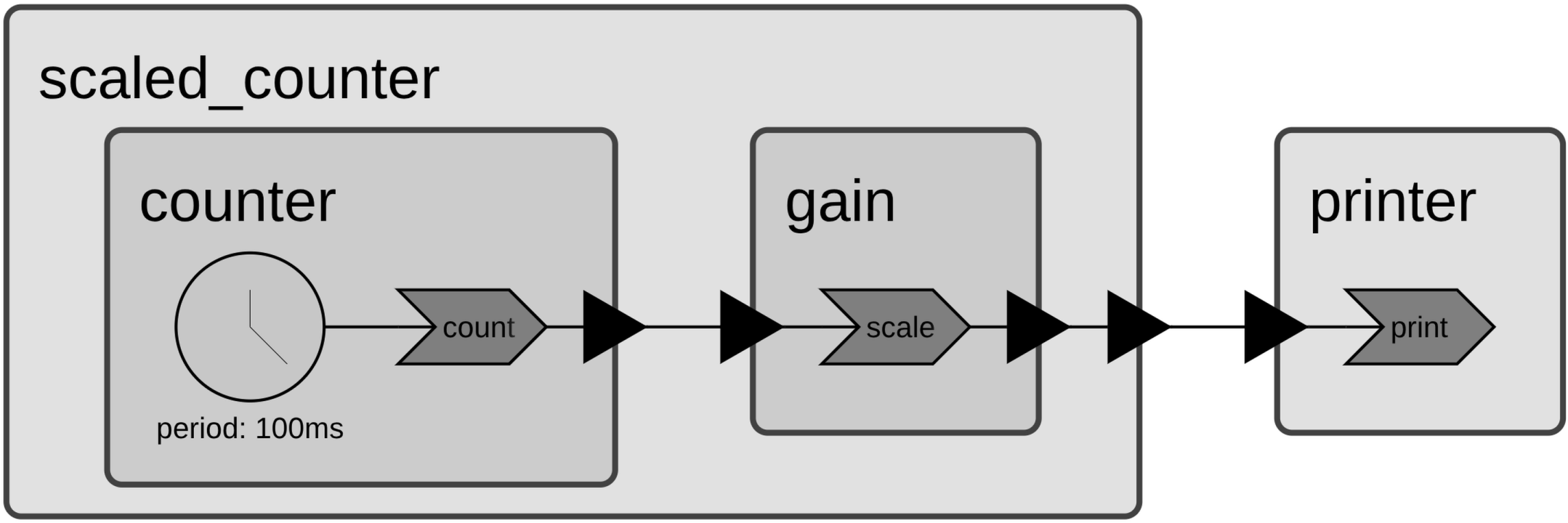
Gain is a simple reactor that multiplies every incoming value by a
configurable factor. ScaledCounter is a container reactor that composes
Counter and Gain into a single component. Its __init__ method calls
create_reactor() to instantiate both as sub-reactors, then uses
connect() to wire them together.
ScaledCounter also declares its own output port. Connecting gain.output
to self.output passes values produced inside the container through to the
outside world. A container’s input port can be forwarded inward in the same
way. From the outside, ScaledCounter looks like any other reactor with an
output port.
Running the program produces output similar to the following:
$ python scaled_counter.py
printer received 3 at 0:00:00
printer received 6 at 0:00:00.100000
printer received 9 at 0:00:00.200000
printer received 12 at 0:00:00.300000
printer received 15 at 0:00:00.400000
printer received 18 at 0:00:00.500000
printer received 21 at 0:00:00.600000
printer received 24 at 0:00:00.700000
printer received 27 at 0:00:00.800000
...
Use Ctrl+C to stop the program.
Reactions accessing nested ports
Instead of (or in addition to) using connect(), a container reactor can define
its own reactions that interact directly with its sub-reactors’ ports. This is
useful when the container needs to apply logic that goes beyond simple
forwarding.
Consider the following modification of ScaledCounter:
class ScaledCounter(xronos.Reactor):
    output = xronos.OutputPortDeclaration()

    def __init__(self, factor):
        super().__init__()
        counter = self.create_reactor("counter", Counter)
        self._gain = self.create_reactor("gain", Gain, factor)
        self.connect(counter.output, self._gain.input_)

    @xronos.reaction
    def on_gain(self, ctx):
        gain_trigger = ctx.add_trigger(self._gain.output)
        output_effect = ctx.add_effect(self.output)

        def handler():
            value = gain_trigger.get()
            if value % 2 != 0:
                output_effect.set(value)

        return handler
class ScaledCounter(xronos.Reactor):
    output = xronos.OutputPortDeclaration[int]()

    def __init__(self, factor: int) -> None:
        super().__init__()
        counter = self.create_reactor("counter", Counter)
        self._gain = self.create_reactor("gain", Gain, factor)
        self.connect(counter.output, self._gain.input_)

    @xronos.reaction
    def on_gain(self, ctx: xronos.ReactionContext) -> Callable[[], None]:
        gain_trigger = ctx.add_trigger(self._gain.output)
        output_effect = ctx.add_effect(self.output)

        def handler() -> None:
            value = gain_trigger.get()
            if value % 2 != 0:
                output_effect.set(value)

        return handler
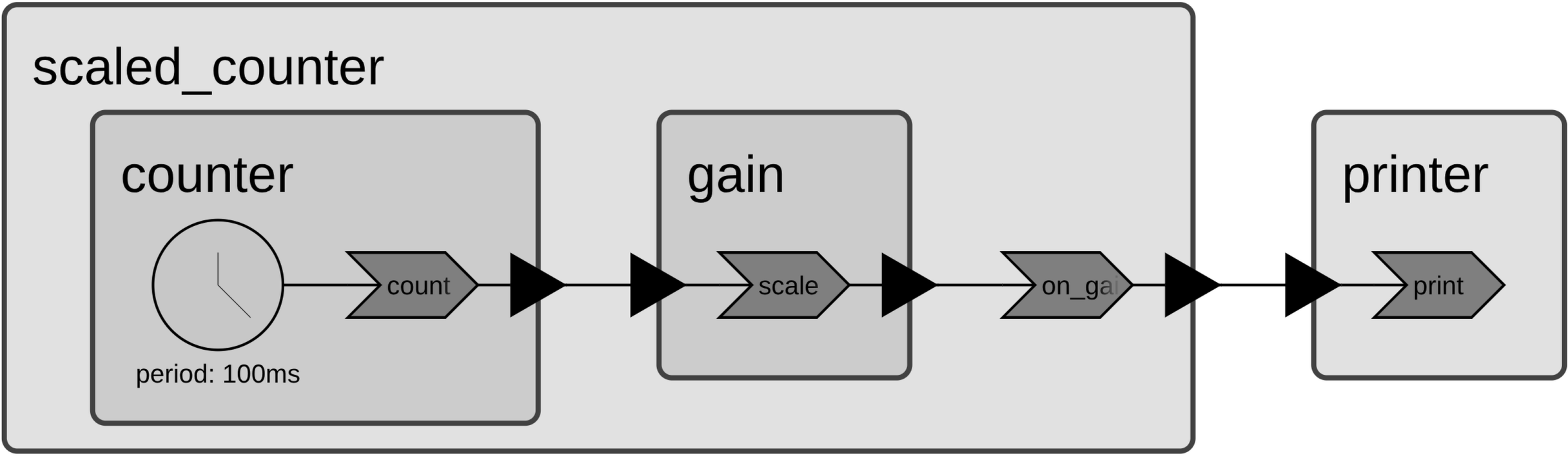
ScaledCounter contains the same Counter and Gain sub-reactors as
before and wires them together in __init__. The difference is that instead of
connecting gain.output directly to self.output, it stores self._gain as
an instance attribute and defines an on_gain reaction.
The reaction passes self._gain.output to
add_trigger(), so it runs every time Gain
produces a value. It also declares self.output as an effect via
add_effect(), which gives the handler a
PortEffect it can write to. The handler reads the scaled value
and only forwards it when it is odd, effectively halving the output rate.
Running this modified program produces output similar to the following:
$ python scaled_counter.py
printer received 3 at 0:00:00
printer received 9 at 0:00:00.200000
printer received 15 at 0:00:00.400000
printer received 21 at 0:00:00.600000
printer received 27 at 0:00:00.800000
...
Use Ctrl+C to stop the program.
Hierarchy rules
Connections, triggers, and effects follow the reactor hierarchy. Each reactor
wires only itself and its direct sub-reactors; nothing reaches deeper into the
hierarchy or across to unrelated reactors. The SDK rejects any declaration
that steps outside these bounds with a ValidationError.
A connection created with connect() may run:
from the reactor’s own input to a sub-reactor’s input,
from a sub-reactor’s output to the reactor’s own output,
from a sub-reactor’s output to a sub-reactor’s input (including itself), or
from the reactor’s own input to its own output.
Environment.connect() follows the same
rules, with the top-level reactors in the role of the sub-reactors.
A reaction may trigger on its own reactor’s timers, physical events, input ports, startup, and shutdown, and on a sub-reactor’s output port. It may declare effects on its own reactor’s output ports, programmable timers, and shutdown, and on a sub-reactor’s input port. These rules give every port a single well-defined place where its values are produced.